Showing posts with label accra. Show all posts

Monday, October 28, 2013

Former American Embasssy

Have you ever noticed there is an entire sequence of "former American embassies" in Accra? (I won't even broach the geopolitical significance.) People still use all of them as landmarks, even though half the time there's a mix-up: "No...the *other* former American embassy!" The first of these, now the Ministry of Women and Children, is — along with the Scott House and half of KNUST — one of my favorite buildings of Ghana's original run of "Tropical Modernism". (There's another former American embassy site behind Design House, near Dankwa Circle.)


Image source: US State Department


Image source: Peter Tolkin Architecture with Mabel E. Wilson - "Listening There" / Studio X

It was designed by Harry Weese, an architect whom otherwise I've never heard of but has done some fascinating work. In Place Journal, Ian Baldwin suggests that Weese's relative obscurity, compared to his contemporaries like Rudolph and Kahn, may derive from his having never taught at Yale (I find this especially interesting because the design cabal of the Ivy League continues to define who gets deified and who doesn't, often independently from the quality of the work), or the fact that his production was more diverse — in style, form, program and geography — which made it harder to encapsulate or describe in an easily marketable brand, and therefore harder for critics and scholars to explain and theorize:

"Weese avoided specializing in a single building type, and his work covers an astonishing range of scales and programs, from transit systems to townhomes and hotels to corporate headquarters. The commission that first put Weese on the map, in 1958, was the U.S. Embassy in Accra, Ghana, a handsome rectangle of offices with projecting bays of louvered mahogany. It is elevated on white tapered columns around a central courtyard, leaving the entire ground floor accessible — too much so for the security concerns of later decades, which forced the embassy to relocate. It is now, in something of a rebuttal to Weese's postcolonial critics, a Ghanaian government ministry." [Places]

The building looks like a disaster today, a half-forgotten icon of a different era: when Maxwell Fry, the father of Tropical Modernism, said "“I have practiced architecture at a time when architects were full of hope and optimism — at a time when we felt that the changes in planning and in architecture would change living conditions and improve the world. A time when there was great hope for the future.”1 A half-century later, the battery of air conditioners of different ages and makes, together with the long-drained pool, underscore the tension between a modern architecture that references aspects of vernacular tradition (wood, natural ventilation, courtyards and open access, etc.) that ultimately finds itself in juxtaposition with users that aspire to a different form of modernity (glass, air conditioning, enclosure and artificiality).

1. Jane Drew, "Recent Work by Fry Drew Partners and Fry, Drew, Drake and Lasdun," Architectural Design, May 1955, 139. via: Mabel Wilson and Peter Tolkin, Place Journal.

Sunday, March 17, 2013

5 notes on the maker future

This is a long-overdue follow-up on the maker breakout session from Barcamp Accra in December 2012. (Now a Facebook group) Thanks to @gamelmag, @annawab and @Abocco for reminding me to kick this back into gear.


“...Ghanaians are by nature makers. They improvise, use what they have at a particular moment to solve an immediate problem that needs to be solved but when it comes to taking this ability and using it to solve more intricate problems, it becomes utterly impossible. And if this ability of 'survival' can be developed upon the maker movement will definitely grow. The session focused finding answers to this problems and answering questions like who is a maker? Bottom line; a maker is synonymous to a hacker and we can say a hacker is someone who exploits the small resources available and manipulates it to produce immense results.It was also realised that makers exist in the country but the lack of network between makers in the country is why the maker community is not so vibrant. Helping makers network is one fantastic way to create a maker community in the country.”

If we substitute “we” for “they,” then this post sums the vision up well. We want to do more and do bigger. Look around you and you will likely see symptoms of Ghana’s import-dependency syndrome. Too often we feel like “quality” is more likely to come from “outside,” when all around people are already making things, many of them excellent.

How can we take this “maker culture” that already exists in Ghana to the next level: nurture it, network makers, pioneer new ways of making and new things to make — in order to incubate new and more dynamic opportunities for makers in the country and on the continent? In short, how do we want to craft this movement?

The theme of last year's Barcamp Accra was: "Removing fear of failure as a start of success." This is incredible advice and a great goal because it's true: far too often it is our fear of failure that prevents us from reaching our greatest potential. Not only because we "psych ourselves out" every step of the way, but because our fear blinds us from even visualizing the full extent of what is possible. Fear limits our vision; it can prevent us from thinking just as much as from trying. Another way of putting this that I keep hearing (don't know original source) is: What would you do if you knew that you could never fail?

Last December, the conversation ranged, organically, across a huge spectrum. Because of the energy and the intensity, I lost track of who said what. So what follows are less notes than they are highlights and ideas, born of that conversation.


#1 We need to reinvent popular education for the 21st century. The notion that you only "learn" in school is dead. (Ever heard of Youtube? What about MOOCs?) Technology today enables new tools and platforms for sharing information and creating knowledge. It's up to us to figure out how best to use these tools and to make new ones. Especially when formal educational structures fail us, we should take that as an incentive to "hack the system." Ask yourself how useful what you're learning is? Can you imagine other ways to learn? Other things you'd rather learn? Ways to help other people learn? The future is about not only life-long learning, but also massively-scaled co-production of knowledge.


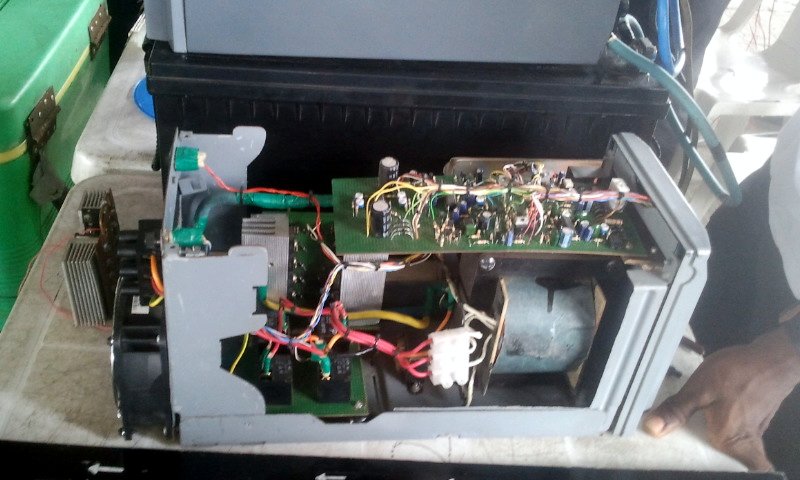
DIY inverter at Maker Faire Africa

#2 Makers hack objects. One of the most amazing things about Maker Faire Africa last year in Lagos was how many young people got involved. It's not every day that you see middle and high school kids make their own inverter or invent a urine-powered generator! Aside from identifying talent and motivating a new generation of young scientists and engineers, to see youth unafraid to try and make things that do things — and unafraid to fail — underscores how few people share that trait. Many of us think too many things are beyond our comprehension. We do not know how to make furniture or a dress, repair an engine, fix a broken fan or hard drive, or plumb a house. On one hand, that's no big deal; that's why we have specialists: carpenters, seamstresses and tailors, mechanics, electricians, computer engineers and plumbers. But on the other hand, when we fall in the trap of seeing objects as "black boxes" that do things mysteriously, in ways we think we cannot understand, we limit ourselves and what we can do. When that happens at the scale of a country or a continent the problem becomes colossal. Makers are revolutionaries because they regain control over their own lives — via the ability to make the things they use everyday. Plus they have tons of fun doing just that.


#3 Who no know go no. (To quote Chimurenga.) Professor Ayorkor Korsah of Ashesi University made a profound comment that paraphrases roughly as: in Ghana, often people who know how to make things don't/didn't go to school, and people who go to school don't/didn't work with their hands. (She also co-founded the African Robotics Network. Youtube video above shows Frugalbot by Mike and Gabrielle Robinson, one of my favorites from AFRON's "10 dollar robot challenge". We need alternatives to imported rubber tyres.) Someone else offered that this represents a fundamental schism in society (and therefore Ghana's technology culture) between "those who know book and those who don't." Whereas many of the people who actually make things in Ghana lack the added technical base that comes with formal or advanced education, many people privileged with education are overexposed to theory, and underexposed to practical — and even view the idea of "getting their hands dirty" as beneath them. People who are proud to proclaim "I'm a graduate!" prefer to work in air-conditioned offices than on a farm, in a workshop or at a factory. This is massively problematic because it means that collectively, through our own cultural biases, we are constraining our capacity to make more and better things by learning from and working with each other. This divide is related to what is sometimes called the difference between "formal" and "informal." Radical innovation will occur if we can bridge this gap.

#4 Pictures are powerful. Another maker at the breakout session pointed out that language is nontrivial. Sometimes the words that we use to describe things determine both who understands and how different people understand the same thing. Ghanaian education is generally pretty strong, stellar in some cases, but its important to remember that it is not perfect: it can tend to reward certain kinds of intelligence. The power of the arts is that they leverage imagination. Expanding the role of artists and the arts can engender new visual languages for how we talk about production, support different forms of making and ultimately generate new hybrids of maker free to unleash the power of creative problem-solving.


#5 The future is now. Sometimes it blows my mind how much most people don't realize that the future is already here. If not here, then just around the corner. Robots already make cars and pretty soon will drive them. People can already control machines with their mind (you can buy one here for $300). Citizens already own more drones than the US military (but they can still kill you with a machine gun). Google Glass is about to (start to) go mainstream (There is a reason Google's O/S is called Android; in the end, we'll all be cyborgs.) Humans have maintained a continuous presence in outer space for over a decade, there are hundreds of satellites orbiting our planet (you can track them here) including one 1.5 million miles away tasked with, essentially, nothing more than watching the sun continuously. And that doesn't even touch the on-going revolutions in AI and computation, materials, nanotechnology, renewable energy, pharmaceuticals, genetics, neuroscience and biochemistry more broadly. So what does all this mean? It means that we're changing the future — and its better to make your own future than to spend all your foreign exchange trying to buy it from someone else.

This post is too long, so next steps to follow. Are you a maker? Join us at Ghana Makers.
Template developed by Confluent Forms LLC; more resources at BlogXpertise