Tuesday, March 19, 2013


Geometric stellation
 |
| stellation locates an ordered array of intersections |
The geometric transformation of stellation (Wikipedia): "Stellation is a process of constructing new polygons (in two dimensions), new polyhedra in three dimensions, or, in general, new polytopes in n dimensions. The process consists of extending elements such as edges or face planes, usually in a symmetrical way, until they meet each other again. The new figure is a stellation of the original."
Net (relational diagram) of such a process can be projected or translated between dimensions, e.g. from 3D to 2D.
Monday, March 18, 2013
Voltascapes
 |
| VRA & 'Garden City' concept |
Block quote from introduction to Voltascapes: Rural Interventions architecture design thesis:
"Volta River Project – New Towns
“It is important to reflect upon the heritage that the ex-colonial countries have left in developing countries all over the world: India, Africa, South-America and the Orient. This heritage that comprises both the good and the bad has been the point of departure for urban development after independence. . . . Today all these countries are autonomous. And even if the heritage of the past has not always made things easier, they have the possibility of decision in their hands. But this possibility of decision is extremely limited because the means for study and realization does not exist”. Michel Ecochard
One such gargantuan project was the Volta River Project (VRA) – also once called the Golden Triangle Project – which was intended to industrialize the country through the exploitation of its natural resources, minerals and water power. The Volta River Project consisted of the Ajena Power Development, new railways, the Bui Gorge Hydro-Electrical Project, the Aya Bauxite mines, Tema Harbour, Tema New Town, the Kpong Smelter and the resettlement of over 80,000 people in 52 New Towns along the newly created Volta Lake.
The project had been on the drawing board before independence, but was put into effect by then Prime Minister Dr. Kwame Nkrumah as a part of his post-independence agenda of Pan–Africanism: an agenda designed to yield a prosperous and stable African country able to take care of its own affairs.
But today, however, most of the New Towns are ruined or deserted and the following three focal points of the VRA – intended to resettle the flood victims in the New Towns in what could be termed a process of ‘imposed modernity’ – have been failures.
- To use the resettlement as an opportunity to enhance the social, economic and physical condition of the people.
This has not resulted in improved conditions, but rather in deprivation, something possibly due to the cash and food handouts at the beginning of the programme.
Insufficient social and economic infrastructure was provided to sustain the growth. Not even basic amenities were provided with the housing.
- To improve their system of agriculture and so enable residents to effect a transition from subsistence agriculture to commercial farming.
Not enough farm land was provided. In addition, most traditional inhabitants lived on or near their farm lands, not in distant houses.
- To plan and locate the New Town in a rational manner so that those resettled, as well as others (the host community) in the Volta Basin would benefit from the creation of the lake.
Since not enough infrastructure was provided, no one benefitted from the programmes. The plan also resulted in problems with sanitation and overcrowding"

Takes me back.
Sunday, March 17, 2013
5 notes on the maker future
This is a long-overdue follow-up on the maker breakout session from Barcamp Accra in December 2012. (Now a Facebook group) Thanks to @gamelmag, @annawab and @Abocco for reminding me to kick this back into gear.

If we substitute “we” for “they,” then this post sums the vision up well. We want to do more and do bigger. Look around you and you will likely see symptoms of Ghana’s import-dependency syndrome. Too often we feel like “quality” is more likely to come from “outside,” when all around people are already making things, many of them excellent.
How can we take this “maker culture” that already exists in Ghana to the next level: nurture it, network makers, pioneer new ways of making and new things to make — in order to incubate new and more dynamic opportunities for makers in the country and on the continent? In short, how do we want to craft this movement?
The theme of last year's Barcamp Accra was: "Removing fear of failure as a start of success." This is incredible advice and a great goal because it's true: far too often it is our fear of failure that prevents us from reaching our greatest potential. Not only because we "psych ourselves out" every step of the way, but because our fear blinds us from even visualizing the full extent of what is possible. Fear limits our vision; it can prevent us from thinking just as much as from trying. Another way of putting this that I keep hearing (don't know original source) is: What would you do if you knew that you could never fail?
#1 We need to reinvent popular education for the 21st century. The notion that you only "learn" in school is dead. (Ever heard of Youtube? What about MOOCs?) Technology today enables new tools and platforms for sharing information and creating knowledge. It's up to us to figure out how best to use these tools and to make new ones. Especially when formal educational structures fail us, we should take that as an incentive to "hack the system." Ask yourself how useful what you're learning is? Can you imagine other ways to learn? Other things you'd rather learn? Ways to help other people learn? The future is about not only life-long learning, but also massively-scaled co-production of knowledge.
#2 Makers hack objects. One of the most amazing things about Maker Faire Africa last year in Lagos was how many young people got involved. It's not every day that you see middle and high school kids make their own inverter or invent a urine-powered generator! Aside from identifying talent and motivating a new generation of young scientists and engineers, to see youth unafraid to try and make things that do things — and unafraid to fail — underscores how few people share that trait. Many of us think too many things are beyond our comprehension. We do not know how to make furniture or a dress, repair an engine, fix a broken fan or hard drive, or plumb a house. On one hand, that's no big deal; that's why we have specialists: carpenters, seamstresses and tailors, mechanics, electricians, computer engineers and plumbers. But on the other hand, when we fall in the trap of seeing objects as "black boxes" that do things mysteriously, in ways we think we cannot understand, we limit ourselves and what we can do. When that happens at the scale of a country or a continent the problem becomes colossal. Makers are revolutionaries because they regain control over their own lives — via the ability to make the things they use everyday. Plus they have tons of fun doing just that.
#3 Who no know go no. (To quote Chimurenga.) Professor Ayorkor Korsah of Ashesi University made a profound comment that paraphrases roughly as: in Ghana, often people who know how to make things don't/didn't go to school, and people who go to school don't/didn't work with their hands. (She also co-founded the African Robotics Network. Youtube video above shows Frugalbot by Mike and Gabrielle Robinson, one of my favorites from AFRON's "10 dollar robot challenge". We need alternatives to imported rubber tyres.) Someone else offered that this represents a fundamental schism in society (and therefore Ghana's technology culture) between "those who know book and those who don't." Whereas many of the people who actually make things in Ghana lack the added technical base that comes with formal or advanced education, many people privileged with education are overexposed to theory, and underexposed to practical — and even view the idea of "getting their hands dirty" as beneath them. People who are proud to proclaim "I'm a graduate!" prefer to work in air-conditioned offices than on a farm, in a workshop or at a factory. This is massively problematic because it means that collectively, through our own cultural biases, we are constraining our capacity to make more and better things by learning from and working with each other. This divide is related to what is sometimes called the difference between "formal" and "informal." Radical innovation will occur if we can bridge this gap.
#4 Pictures are powerful. Another maker at the breakout session pointed out that language is nontrivial. Sometimes the words that we use to describe things determine both who understands and how different people understand the same thing. Ghanaian education is generally pretty strong, stellar in some cases, but its important to remember that it is not perfect: it can tend to reward certain kinds of intelligence. The power of the arts is that they leverage imagination. Expanding the role of artists and the arts can engender new visual languages for how we talk about production, support different forms of making and ultimately generate new hybrids of maker free to unleash the power of creative problem-solving.
#5 The future is now. Sometimes it blows my mind how much most people don't realize that the future is already here. If not here, then just around the corner. Robots already make cars and pretty soon will drive them. People can already control machines with their mind (you can buy one here for $300). Citizens already own more drones than the US military (but they can still kill you with a machine gun). Google Glass is about to (start to) go mainstream (There is a reason Google's O/S is called Android; in the end, we'll all be cyborgs.) Humans have maintained a continuous presence in outer space for over a decade, there are hundreds of satellites orbiting our planet (you can track them here) including one 1.5 million miles away tasked with, essentially, nothing more than watching the sun continuously. And that doesn't even touch the on-going revolutions in AI and computation, materials, nanotechnology, renewable energy, pharmaceuticals, genetics, neuroscience and biochemistry more broadly. So what does all this mean? It means that we're changing the future — and its better to make your own future than to spend all your foreign exchange trying to buy it from someone else.
This post is too long, so next steps to follow. Are you a maker? Join us at Ghana Makers.

First, read this post by Nutakor Eldad on the ‘Maker Mentality’:
“...Ghanaians are by nature makers. They improvise, use what they have at a particular moment to solve an immediate problem that needs to be solved but when it comes to taking this ability and using it to solve more intricate problems, it becomes utterly impossible. And if this ability of 'survival' can be developed upon the maker movement will definitely grow. The session focused finding answers to this problems and answering questions like who is a maker? Bottom line; a maker is synonymous to a hacker and we can say a hacker is someone who exploits the small resources available and manipulates it to produce immense results.It was also realised that makers exist in the country but the lack of network between makers in the country is why the maker community is not so vibrant. Helping makers network is one fantastic way to create a maker community in the country.”
If we substitute “we” for “they,” then this post sums the vision up well. We want to do more and do bigger. Look around you and you will likely see symptoms of Ghana’s import-dependency syndrome. Too often we feel like “quality” is more likely to come from “outside,” when all around people are already making things, many of them excellent.
How can we take this “maker culture” that already exists in Ghana to the next level: nurture it, network makers, pioneer new ways of making and new things to make — in order to incubate new and more dynamic opportunities for makers in the country and on the continent? In short, how do we want to craft this movement?
The theme of last year's Barcamp Accra was: "Removing fear of failure as a start of success." This is incredible advice and a great goal because it's true: far too often it is our fear of failure that prevents us from reaching our greatest potential. Not only because we "psych ourselves out" every step of the way, but because our fear blinds us from even visualizing the full extent of what is possible. Fear limits our vision; it can prevent us from thinking just as much as from trying. Another way of putting this that I keep hearing (don't know original source) is: What would you do if you knew that you could never fail?
Last December, the conversation ranged, organically, across a huge spectrum. Because of the energy and the intensity, I lost track of who said what. So what follows are less notes than they are highlights and ideas, born of that conversation.
- Science cafés as a model (via Gameli Adzaho).
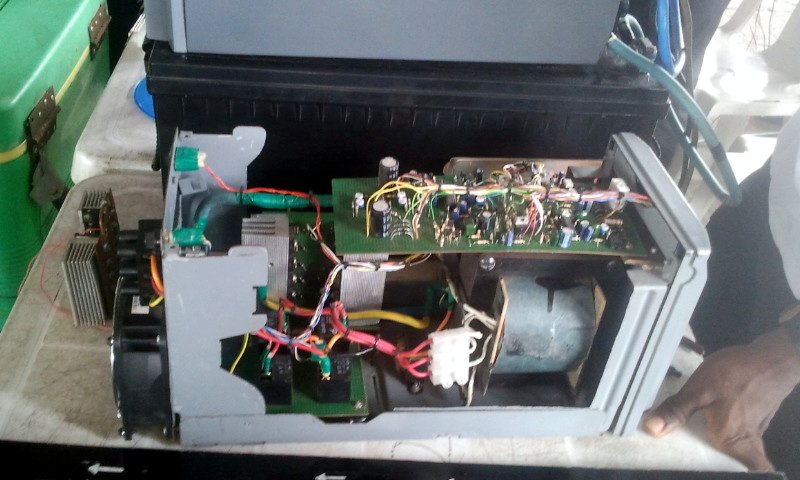 |
| DIY inverter at Maker Faire Africa |
#2 Makers hack objects. One of the most amazing things about Maker Faire Africa last year in Lagos was how many young people got involved. It's not every day that you see middle and high school kids make their own inverter or invent a urine-powered generator! Aside from identifying talent and motivating a new generation of young scientists and engineers, to see youth unafraid to try and make things that do things — and unafraid to fail — underscores how few people share that trait. Many of us think too many things are beyond our comprehension. We do not know how to make furniture or a dress, repair an engine, fix a broken fan or hard drive, or plumb a house. On one hand, that's no big deal; that's why we have specialists: carpenters, seamstresses and tailors, mechanics, electricians, computer engineers and plumbers. But on the other hand, when we fall in the trap of seeing objects as "black boxes" that do things mysteriously, in ways we think we cannot understand, we limit ourselves and what we can do. When that happens at the scale of a country or a continent the problem becomes colossal. Makers are revolutionaries because they regain control over their own lives — via the ability to make the things they use everyday. Plus they have tons of fun doing just that.
#3 Who no know go no. (To quote Chimurenga.) Professor Ayorkor Korsah of Ashesi University made a profound comment that paraphrases roughly as: in Ghana, often people who know how to make things don't/didn't go to school, and people who go to school don't/didn't work with their hands. (She also co-founded the African Robotics Network. Youtube video above shows Frugalbot by Mike and Gabrielle Robinson, one of my favorites from AFRON's "10 dollar robot challenge". We need alternatives to imported rubber tyres.) Someone else offered that this represents a fundamental schism in society (and therefore Ghana's technology culture) between "those who know book and those who don't." Whereas many of the people who actually make things in Ghana lack the added technical base that comes with formal or advanced education, many people privileged with education are overexposed to theory, and underexposed to practical — and even view the idea of "getting their hands dirty" as beneath them. People who are proud to proclaim "I'm a graduate!" prefer to work in air-conditioned offices than on a farm, in a workshop or at a factory. This is massively problematic because it means that collectively, through our own cultural biases, we are constraining our capacity to make more and better things by learning from and working with each other. This divide is related to what is sometimes called the difference between "formal" and "informal." Radical innovation will occur if we can bridge this gap.
#4 Pictures are powerful. Another maker at the breakout session pointed out that language is nontrivial. Sometimes the words that we use to describe things determine both who understands and how different people understand the same thing. Ghanaian education is generally pretty strong, stellar in some cases, but its important to remember that it is not perfect: it can tend to reward certain kinds of intelligence. The power of the arts is that they leverage imagination. Expanding the role of artists and the arts can engender new visual languages for how we talk about production, support different forms of making and ultimately generate new hybrids of maker free to unleash the power of creative problem-solving.
#5 The future is now. Sometimes it blows my mind how much most people don't realize that the future is already here. If not here, then just around the corner. Robots already make cars and pretty soon will drive them. People can already control machines with their mind (you can buy one here for $300). Citizens already own more drones than the US military (but they can still kill you with a machine gun). Google Glass is about to (start to) go mainstream (There is a reason Google's O/S is called Android; in the end, we'll all be cyborgs.) Humans have maintained a continuous presence in outer space for over a decade, there are hundreds of satellites orbiting our planet (you can track them here) including one 1.5 million miles away tasked with, essentially, nothing more than watching the sun continuously. And that doesn't even touch the on-going revolutions in AI and computation, materials, nanotechnology, renewable energy, pharmaceuticals, genetics, neuroscience and biochemistry more broadly. So what does all this mean? It means that we're changing the future — and its better to make your own future than to spend all your foreign exchange trying to buy it from someone else.
This post is too long, so next steps to follow. Are you a maker? Join us at Ghana Makers.
Friday, March 15, 2013
Hope City

I need to do a real post on this project, but in the meantime: this pic says it all. If you don't know, read about it: Rlg Communications, a Ghanaian IT company, is building over the next three years a $10 billion technology park in Dunkonaa, near Kasoa in Greater Accra, in a PPP with GoG (can you say STX and sovereign guarantee?) which is to include Africa's tallest building, designed by Paolo Brescia of Italian architecture firm Open Building Research.
Tuesday, February 5, 2013
Stellation


Monday, January 21, 2013

Subscribe to:
Posts (Atom)